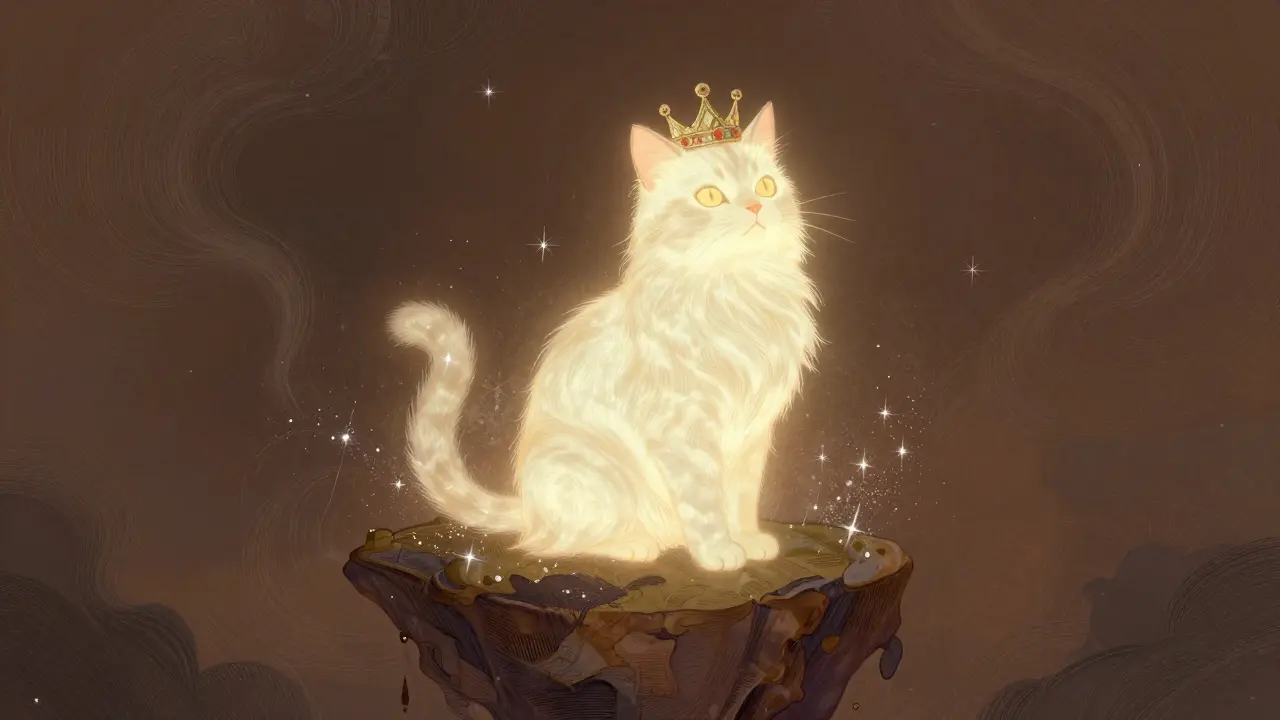
Ever wonder how AI can generate a photo of a cat wearing a crown on a floating island, with sunlight catching every strand of fur, and not look like a glitchy collage? The answer isn’t magic. It’s noise removal. That’s the core idea behind diffusion models - the technology now powering most of the photorealistic images you see online.
Before diffusion models, AI image generators mostly relied on GANs (Generative Adversarial Networks). They were fast, but they had a nasty habit of breaking. A GAN might generate a perfect face - until you asked for two hands. Then you’d get three fingers, or a palm where an ear should be. It was like a painter who could nail a portrait but couldn’t draw a hand without staring at a reference for hours. Diffusion models fixed that. Not by being smarter, but by being more patient.
How Noise Turns Into a Picture
Think of a photo as a carefully arranged pile of pixels. Now imagine slowly sprinkling static on it - like snow falling over a window. Step by step, you add more noise. After 1,000 steps, the image is pure static. That’s the forward process. It’s not magic. It’s math. Gaussian noise, added in tiny amounts, following a precise schedule. The result? A clean signal is turned into randomness.
The real trick is the reverse.
The model doesn’t try to guess what the original image looked like. Instead, it learns to remove one layer of noise at a time. At each step, it looks at the noisy image and asks: “What did this look like before I added this bit of noise?” It’s not predicting the whole image. It’s predicting just the noise. And it gets better at this with every training example. Millions of them.
This is why diffusion models don’t hallucinate as badly as GANs. They’re not guessing from scratch. They’re undoing a known process. The model has seen thousands of images go from sharp to noisy - so it knows exactly how to reverse it. The result? Skin textures that look real, shadows that behave like light, reflections that match the environment. Even hair strands - something GANs struggled with - now render with natural variation.
Why This Beats GANs
GANs work in pairs: one network tries to make fake images, another tries to spot them. It’s a tug-of-war. And when one side gets too strong, the whole thing collapses. That’s called mode collapse. A GAN trained on faces might only ever generate five different expressions - over and over. It’s lazy. It takes the easiest path.
Diffusion models don’t have that problem. They’re not competing. They’re learning a path. And that path is mathematically stable. According to NVIDIA’s 2023 benchmarks, diffusion models hit an average FID score of 1.70 on CIFAR-10. GANs? 2.57. Lower FID means closer to real images. That gap isn’t small. It’s the difference between a blurry photo and a sharp one.
And the numbers don’t stop there. On CelebA-HQ, a dataset of high-res human faces, diffusion models scored 2.14 FID. GANs? 3.89. That’s nearly double the error rate. In real terms? A GAN might make a face with mismatched eyes. A diffusion model? It gets the spacing right. The lighting. The pores.
Training success rates tell the story too. GANs fail to train properly 35% of the time. Diffusion models? They succeed 98% of the time. No more wrestling with unstable training. No more hours spent tweaking hyperparameters. Just train. And it works.
How Stable Diffusion Changed Everything
The real game-changer wasn’t just the theory. It was accessibility.
Before 2022, you needed a supercomputer to train a diffusion model. OpenAI’s DALL-E 2 took 150,000 GPU hours. That’s the equivalent of one high-end GPU running nonstop for over 17 years.
Then came Stable Diffusion - released by Stability AI in 2022. Instead of working in pixel space, it compressed the image into a latent space. Think of it like turning a 4K video into a 1080p thumbnail, generating the image there, then blowing it back up. This cut VRAM needs from 10GB to 3GB. Suddenly, you could run it on a consumer GPU.
That’s why it exploded. By December 2023, Stable Diffusion 2.1 had over 12.7 million downloads. People started tweaking it. Adding custom models. Training on their own art. Creating 47,000+ variations on Civitai. A concept artist in Berlin used it to generate 200+ book covers in two weeks - work that used to take her six months. A small studio in Austin cut their product photography costs by 70% by generating mockups for online stores.
But it’s not perfect. Users report weird hands 63% of the time. Text? Still a mess. “Generate a sign that says ‘Open 24 Hours’” often gives you gibberish. Or a sign with no letters at all. And if you change one word in your prompt - “a woman with a red hat” to “a woman wearing a red hat” - the output can shift completely. That’s prompt fragility. It’s like talking to a genius who only understands perfect grammar.
What It Costs - and Who’s Using It
Generating a single 512x512 image on a high-end GPU like an NVIDIA A100 takes 2.3 seconds. On a consumer card? Maybe 8 minutes. That’s why people complain. You can’t iterate fast. You can’t preview. You have to wait.
And training? Still expensive. Even with latent diffusion, training a high-quality model from scratch requires thousands of GPU hours. Most users don’t do that. They download a pre-trained model. That’s why Hugging Face’s Diffusers library is used in 89% of implementations. It’s the toolkit. The starter pack.
Who’s using this? According to Adobe’s 2023 report, 42% of users are professional creatives. Designers. Artists. Illustrators. Then developers (29%). Marketing teams (18%). And companies? 62% of Fortune 500 firms now use diffusion models - mostly for internal design, never for customer-facing ads. Why? Because of the risk. A product image with a missing button or a floating arm could mean returns. Shopify’s 2023 case study found 35% higher return rates when stores used AI-generated product photos.
The Future: Faster, Smarter, Smaller
Right now, diffusion models are slow. They need 20 to 50 steps to generate an image. Each step is a prediction. Each prediction takes time. But researchers are working on shortcuts.
In January 2024, a team from MIT showed a new method called “flow matching” that cuts steps from 50 down to 2 or 3. That’s not theory. It’s working. OpenAI plans to launch “real-time diffusion” by Q3 2024 - meaning generation in under a second. Meta is open-sourcing SeamlessM4T in June 2024, letting you generate images from audio, text, or video. And NVIDIA’s TensorRT-LLM update in January 2024 slashed inference time by 4.2x.
Stability AI’s Stable Diffusion 3, released in late 2023, reduced object duplication errors by 63%. That means if you ask for “two dogs playing,” you get two dogs - not one dog copied twice. Google’s Veo now generates 16-second video clips at 1080p. That’s not animation. That’s video.
By 2026, analysts predict a 90% drop in computational cost. That means you’ll be able to run high-quality diffusion models on your phone. Not just generate images - edit them in real time. Change the lighting. Swap out the background. Remove a person. All without a server.
What You Need to Know
If you’re curious about trying this:
- Start with Stable Diffusion 2.1 - it’s the most stable, well-documented version.
- You need at least 6GB of VRAM. 12GB is better for 1024x1024 images.
- Use Hugging Face’s Diffusers library. It handles the math so you don’t have to.
- Learn negative prompting. Saying “no blurry hands, no extra fingers, no text” cuts errors by half.
- Don’t trust AI for product photos. Use it for concept art. Not for final sales.
The magic isn’t in the noise. It’s in the removal. Every pixel you see was once a mess. And the model learned, step by step, how to clean it up. That’s why it works. Not because it’s smart. But because it’s patient.
How do diffusion models differ from GANs in generating images?
GANs use two networks that compete - one creates images, the other judges them. This often leads to unstable training and glitches like missing limbs or repeated objects. Diffusion models work by gradually adding noise to an image, then learning to reverse that process. Instead of guessing the whole image at once, they remove noise step-by-step. This results in more consistent, detailed outputs, especially in complex scenes. They also train successfully 98% of the time, compared to just 65% for GANs.
Why are diffusion models slower than GANs?
Diffusion models generate images through a sequence of 20 to 50 steps, each requiring a separate neural network prediction to remove a layer of noise. GANs generate an image in one single pass. That makes GANs faster - often 10 times faster. But speed comes at the cost of quality. Diffusion models trade time for detail, coherence, and fewer artifacts. New techniques like flow matching aim to cut steps down to 2 or 3, which could close this gap by 2025.
Can I run diffusion models on a regular computer?
Yes - if your GPU has at least 6GB of VRAM. Models like Stable Diffusion 2.1 run on consumer cards like the RTX 3060 or RTX 4070. For 512x512 images, 6GB is the minimum. For 1024x1024 or higher, you’ll want 12GB or more. Cloud services like Runway ML or Google Colab offer free access if you don’t have the hardware. Latency varies: 2 seconds on an A100, up to 8 minutes on a mid-tier gaming GPU.
What are the biggest problems with current diffusion models?
The top issues are: 1) Poor handling of hands and text - fingers often have extra joints or vanish entirely; 2) Prompt fragility - small wording changes produce wildly different results; 3) High computational cost - even with optimizations, generating images takes time and power; 4) Lack of real-time control - you can’t tweak an image live like in Photoshop. These are being actively improved, but they’re still common pain points for users.
Are diffusion models used in real businesses today?
Yes - 62% of Fortune 500 companies use them, mostly for internal design, marketing mockups, and product visualization. Companies like Nike and Adobe use them to generate concept art, packaging layouts, and ad variations. But few use them for final customer-facing images because of consistency risks - like a product photo with a missing button or distorted texture. Regulatory rules in the EU and California now require watermarking AI-generated content, which is pushing adoption toward internal use first.
What’s next for diffusion models?
The next big leaps are in speed and control. OpenAI plans real-time generation by late 2024. Meta will open-source multimodal diffusion (text, audio, video) in mid-2024. Researchers are testing methods that cut generation steps from 50 to just 2 or 3. By 2026, analysts expect 90% less computing power needed. That means mobile apps, live editing, and real-time video generation. Long-term, diffusion models are expected to dominate until at least 2028 - unless a new architecture emerges that matches their quality without the cost.




Megan Blakeman
March 20, 2026 AT 01:00Okay, but can we just appreciate how wild it is that we went from ‘AI can’t draw hands’ to ‘AI can render sunlight on fur’? I cried the first time I saw a generated cat with actual individual whiskers. 🥹
Akhil Bellam
March 20, 2026 AT 13:02Oh, so we’re glorifying noise removal now? How quaint. GANs were elegant-minimalist, efficient, poetic. This? It’s like using a bulldozer to clean a teacup. You didn’t solve the problem-you just threw 50 neural net layers at it until it stopped looking like a nightmare. And don’t get me started on ‘latent space’-it’s just compression with a PhD. 🤓
Amber Swartz
March 22, 2026 AT 10:04MY GOD. I GENERATE A PICTURE OF A WOMAN IN A RED DRESS AND SHE HAS FOUR ARMS. FOUR. ARMS. AND THEN I CHANGE ‘RED DRESS’ TO ‘RED DRES’ AND NOW SHE’S WEARING A CLOAK MADE OF FISH. I’M NOT EVEN KIDDING. I’M JUST ASKING FOR A DRESS. A DRESS. NOT A SEA MONSTER. I’M OUT. 🤬
Robert Byrne
March 24, 2026 AT 07:21Stop. Just stop. You’re all missing the point. The real issue isn’t the hands or the text-it’s that people treat this like a magic wand. You don’t just type ‘photorealistic CEO with a golden beard’ and get a LinkedIn profile pic. You need to understand lighting, composition, perspective. This isn’t art-it’s a feedback loop between your prompt engineering and the model’s training bias. And if you’re not debugging your prompts like a programmer, you’re wasting your time. And your GPU. 🤖
Tia Muzdalifah
March 25, 2026 AT 01:03so like… i tried it on my phone using a web app and it made this weird dragon with a laptop for a head?? and then i asked for ‘a dog wearing sunglasses’ and it gave me a pug with two pairs of shades?? i just wanted a chill dog 😅 but i’m obsessed. like… this is the future? i’m lowkey scared but also excited??
Zoe Hill
March 26, 2026 AT 03:24I just want to say thank you for writing this so clearly. I’m not techy at all, but I finally get it. It’s not magic-it’s like learning to unscramble a puzzle one piece at a time. And the part about training success rates? That made me feel so much better. I’ve wasted so many hours on GANs and thought I was just bad at it. Turns out, the tech was just broken. 💛
Albert Navat
March 27, 2026 AT 09:17Look, if you’re still running diffusion models on consumer hardware, you’re doing it wrong. You’re not ‘saving money’-you’re bottlenecking your workflow. The real value isn’t in generating images-it’s in scaling inference via distributed tensor cores and quantized latent transformers. If you’re not using TensorRT-LLM with FP8 precision and dynamic batching, you’re running a 2022 pipeline on 2024 hardware. And yes, I’ve benchmarked it. 4.2x faster? That’s the floor. You’re not optimizing-you’re just clicking buttons. 🚫
King Medoo
March 27, 2026 AT 11:34Let me be clear: this isn’t progress. This is surrender. We used to dream of machines that could create from imagination. Now we’re teaching them to undo noise like a child erasing crayon marks. It’s not art. It’s a statistical mirage. And the fact that people are calling this ‘the future’? It’s pathetic. We’re outsourcing creativity to a system that doesn’t understand light, emotion, or meaning. It just remembers patterns. And we’re letting it replace artists. 🤡