Imagine you train a massive Large Language Model (LLM) on millions of patient records. The model learns to predict diagnoses with incredible accuracy. But when you ask it a specific question, it spits out a real person's name and address. That’s the nightmare scenario of Differential Privacy in Generative AI. It’s not just about hiding data; it’s about mathematically proving that no single individual’s contribution can be identified from the output. As we move deeper into the era of responsible AI, understanding how to apply differential privacy during both training and inference is no longer optional-it’s a compliance requirement and a trust builder.
The Core Problem: Why Standard Anonymization Fails
You might think removing names and IDs is enough. Think again. In 2008, researchers Narayanan and Shmatikov proved that Netflix’s "anonymized" movie ratings could be re-identified by cross-referencing them with public IMDb profiles. This vulnerability exists because models memorize patterns. When a Generative AI model overfits, it doesn’t just learn general trends; it memorizes specific sequences from its training set. If your model was trained on sensitive emails, it might regurgitate a unique phrase found only in one employee’s inbox.
Differential Privacy (DP) solves this by adding calculated noise to the data or the model updates. Unlike k-anonymity, which relies on grouping individuals, DP provides a formal guarantee: the probability distribution of the model’s output changes very little whether any single individual’s data is included or excluded. This makes it robust against linkage attacks, where adversaries combine multiple datasets to uncover identities.
Training Phase: How DP-SGD Works
The industry standard for implementing differential privacy in deep learning is Differentially Private Stochastic Gradient Descent (DP-SGD). If you’re familiar with standard SGD, you know it calculates gradients based on batches of data and updates weights accordingly. DP-SGD modifies this process in two critical ways to ensure privacy.
First, it performs per-example gradient clipping. Instead of letting outliers dominate the batch average, each example’s gradient is capped at a maximum norm (often between 0.5 and 5.0 for text data). This limits the influence any single data point can have on the model update. Second, it adds calibrated Gaussian noise to the aggregated gradients before applying the weight update. The amount of noise depends on the privacy budget, denoted as epsilon ($\epsilon$).
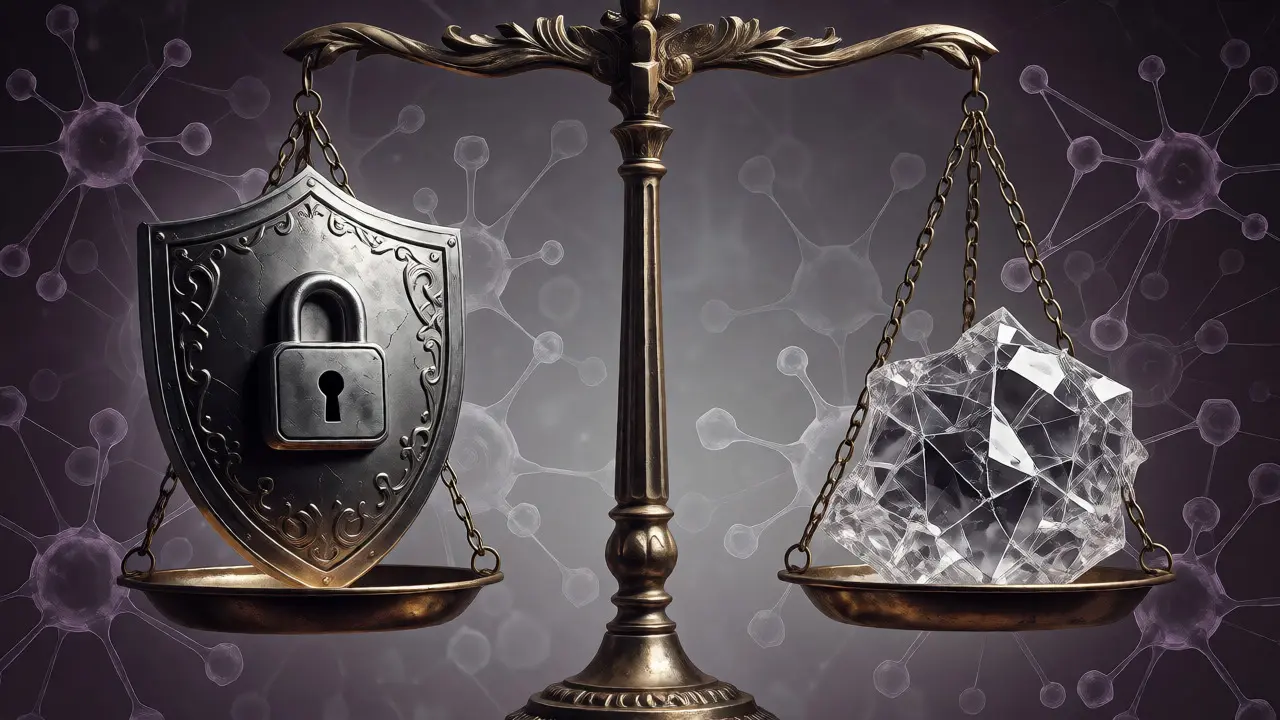
A lower $\epsilon$ means more noise and stronger privacy, but potentially lower model utility. A higher $\epsilon$ allows less noise and better performance, but weaker privacy guarantees. Most organizations find a sweet spot between $\epsilon=1$ and $\epsilon=8$, depending on their risk tolerance. For instance, Apple uses $\epsilon=2$ for location data, while the US Census Bureau operates at $\epsilon=17.1$ for demographic statistics.
| Epsilon ($\epsilon$) | Privacy Level | Typical Use Case | Expected Accuracy Drop |
|---|---|---|---|
| $\epsilon \le 1$ | Very Strong | Healthcare, Legal | 15-25% |
| $\epsilon = 2 - 5$ | Strong | Finance, Retail | 5-15% |
| $\epsilon > 8$ | Moderate | General Analytics | <5% |
Inference Phase: Protecting User Queries
Most discussions focus on training, but inference poses its own risks. When users interact with a Generative AI model, they input prompts that might contain sensitive information. If the model logs these prompts without protection, you’ve leaked data through the API interface. Furthermore, membership inference attacks can determine if a specific record was part of the training set by analyzing the model’s confidence scores on that record.
To mitigate this, developers use techniques like output perturbation. This involves adding noise to the final logits or token probabilities before sampling the next word. Another approach is limiting the number of queries per user within a time window, effectively capping the total privacy loss. Some advanced systems employ local differential privacy, where noise is added to the user’s input on their device before it ever reaches the server. This ensures the service provider never sees the raw sensitive data, though it requires careful tuning to maintain response quality.

Advanced Frameworks: RDP and CDP
Standard $(\epsilon, \delta)$-DP has limitations when dealing with iterative algorithms like neural network training. Each epoch consumes part of the privacy budget, and composing these losses over thousands of steps can lead to loose bounds. Enter Rényi Differential Privacy (RDP). Introduced by Ilya Mironov in 2017, RDP offers tighter composition properties, making it ideal for deep learning. It tracks privacy loss using Rényi divergence, allowing for more precise accounting over many iterations.
Similarly, Concentrated Differential Privacy (CDP) simplifies analysis by focusing on the mean and variance of privacy loss rather than worst-case scenarios. Recent research suggests that switching from standard DP to RDP can improve privacy accounting efficiency by 30-40% for long training runs. Tools like Opacus for PyTorch and TensorFlow Privacy now support these advanced frameworks, helping engineers optimize the trade-off between security and performance.
Implementation Challenges and Solutions
Implementing DP isn’t plug-and-play. The biggest hurdle is computational overhead. Calculating per-example gradients is expensive, often increasing training time by 20-30%. Memory usage also spikes because you need to store intermediate gradient values for every example in the batch. To combat this, practitioners use gradient accumulation and mixed precision training.
Another common issue is choosing the right clipping norm. If you clip too aggressively, you lose important signal; if you clip too loosely, privacy guarantees weaken. Adaptive clipping strategies, which adjust the norm based on the observed gradient distribution, have shown promise in maintaining utility while preserving privacy. Additionally, starting with a pre-trained model and fine-tuning it with DP-SGD can reduce the accuracy penalty compared to training from scratch.
Real-World Applications and Market Trends
The demand for differential privacy is surging, driven by regulations like GDPR and HIPAA. Healthcare leads adoption, accounting for 32% of implementations, followed closely by finance. Companies are realizing that synthetic data generation powered by DP allows them to share datasets for research without exposing patient or customer identities.
For example, Mayo Clinic used DP-SGD to train a medical image classifier with $\epsilon=1.5$. They achieved 88% accuracy-only a 4% drop from the non-private baseline-while passing rigorous privacy audits. In contrast, large language models face steeper challenges. GPT-3-sized models can see 15-20% performance degradation at strict privacy levels, prompting ongoing research into more efficient noise mechanisms.
Frequently Asked Questions
Does differential privacy always ruin model accuracy?
Not necessarily. While there is a trade-off, modern techniques like Rényi Differential Privacy and adaptive clipping minimize the impact. For many applications, an accuracy drop of 5-10% is acceptable given the legal and ethical benefits. Using pre-trained models for fine-tuning also helps preserve utility.
What is the difference between epsilon and delta in differential privacy?
Epsilon ($\epsilon$) controls the privacy loss budget; lower values mean stronger privacy. Delta ($\delta$) represents the probability that the privacy guarantee fails. In practice, $\delta$ is usually set to a very small number, such as $1/n$ where $n$ is the dataset size, ensuring failures are extremely rare.
Can differential privacy prevent hallucinations in LLMs?
Emerging research suggests yes. By preventing overfitting to rare training examples, DP can reduce factual inaccuracies. One study showed a 22% reduction in factual errors at $\epsilon=4$, indicating that privacy constraints may act as a regularization mechanism that improves generalization.
Which libraries should I use for implementing DP?
For PyTorch, Opacus is the leading open-source library. For TensorFlow, use TensorFlow Privacy. Both support DP-SGD and advanced accounting methods like RDP. Commercial solutions like Gretel.ai offer managed services if you prefer not to handle the infrastructure complexity.
Is differential privacy compatible with federated learning?
Yes, and they are often combined. Federated learning keeps data local, while differential privacy protects the aggregated model updates. This combination provides defense-in-depth, protecting against both data leakage and model inversion attacks.