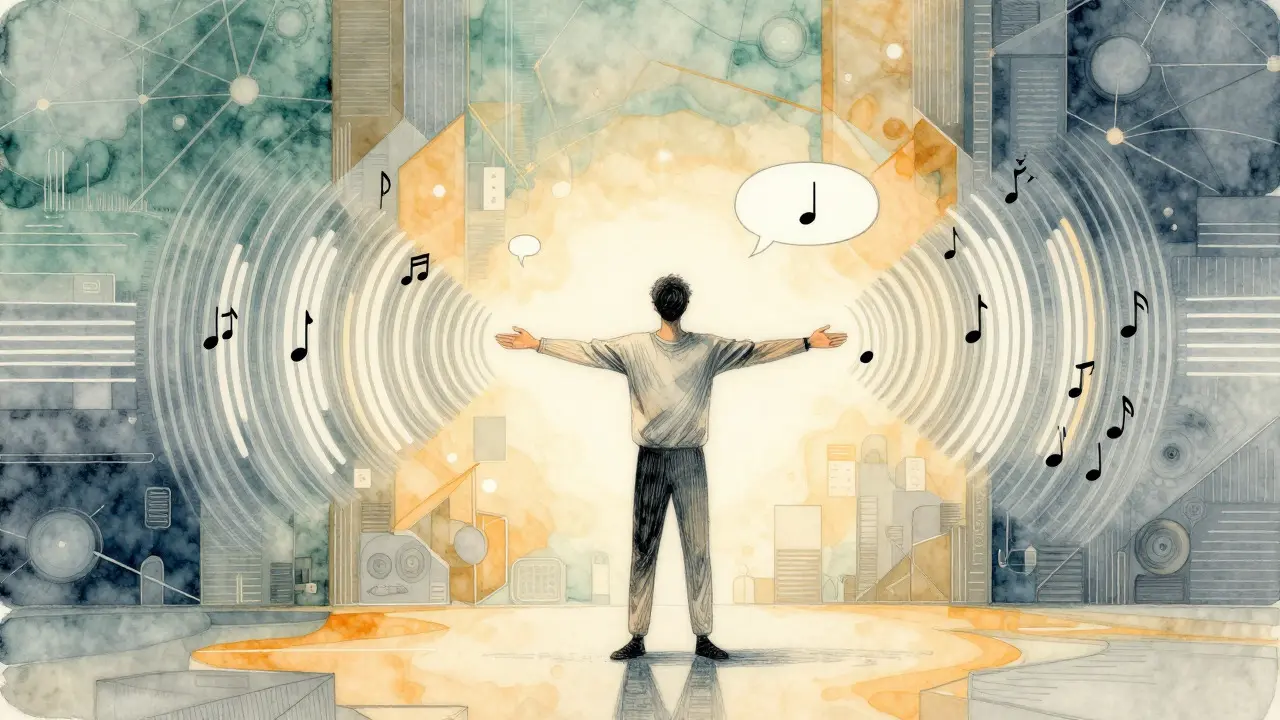
Imagine typing a sentence and hearing it spoken in your own voice, or describing a rainy night with distant thunder and getting a perfectly timed audio clip. That is the reality of audio generation in generative AI today. It is no longer just robotic beeps or lo-fi loops; we are talking about near-human speech, full songs with vocals, and cinematic sound design that rivals professional Foley artists. If you have ever wondered how these tools work under the hood or which one fits your project, you are in the right place.
The landscape has shifted dramatically since 2016. What started as academic experiments with neural networks has exploded into a multi-billion dollar industry powering everything from podcast production to video game soundtracks. Understanding the core technologies-speech synthesis, music composition, and sound effect creation-is essential for anyone navigating this space, whether you are a developer, a content creator, or a curious learner.
How Machines Learn to Make Noise
At its core, Generative Audio is the use of deep learning models to synthesize speech, music, and sound effects from textual, symbolic, or audio prompts. Unlike older rule-based systems that simply stitched together pre-recorded fragments, modern systems learn the statistical patterns of sound itself. They process vast amounts of data to understand what makes a voice sound human, what makes a chord progression feel resolved, or what makes a door slam sound heavy.
Three main architectural approaches dominate this field:
- Transformers: These models excel at handling long-range dependencies. In music, this means understanding how a melody introduced in verse one pays off in the chorus three minutes later. In speech, they help manage prosody and context over longer sentences.
- Diffusion Models: Think of these like painting in reverse. The model starts with pure static noise and iteratively removes the noise until a clean audio waveform emerges. This approach produces highly coherent results, especially for complex textures like rain or orchestral swells.
- Variational Autoencoders (VAEs) and GANs: Earlier architectures that learned compressed representations of audio. While less dominant for raw generation now, their components, like neural codecs, are still crucial for compressing high-quality audio into manageable tokens for other models to process.
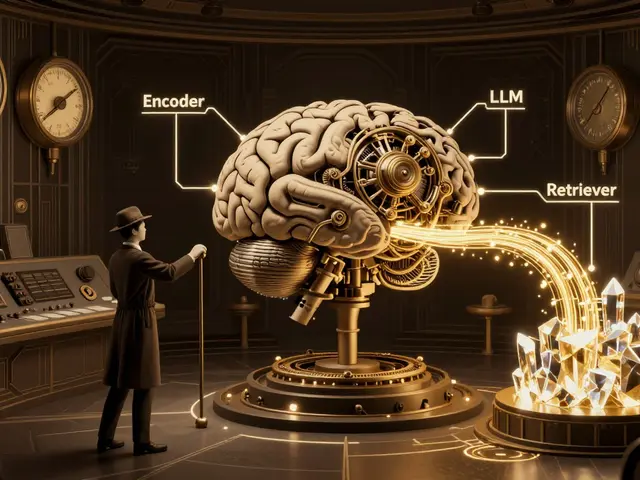
The magic happens in the representation layer. Raw audio is too large and unwieldy for most neural networks. So, engineers convert sound into intermediate formats like mel-spectrograms or discrete codec tokens. A model might predict a sequence of these tokens, which a separate "vocoder" then translates back into audible waves. This separation allows different parts of the pipeline to specialize-one part handles the "what" (the musical notes or words), and the other handles the "how" (the timbre and texture).
Speech Synthesis: From Robotic Beeps to Human Voices
Text-to-Speech (TTS) is the artificial production of human speech by a computer system using neural networks to generate natural-sounding audio. For decades, TTS sounded mechanical because it relied on concatenating recorded syllables. The turning point came in 2016 with DeepMind's WaveNet, which generated audio sample-by-sample, creating incredibly realistic textures. By 2017, Google's Tacotron 2 combined sequence-to-sequence modeling with a vocoder, reaching quality scores nearly indistinguishable from human recordings in blind tests.
Today, the standard pipeline involves three stages:
- Text Analysis: Breaking down input text into phonemes and linguistic features.
- Acoustic Modeling: Predicting the mel-spectrogram, which captures pitch, rhythm, and tone.
- Vocoding: Converting the spectrogram into a raw audio waveform at high sampling rates (typically 16-48 kHz).
One of the most exciting developments here is Voice Cloning is a specialized application where a model learns a specific speaker's unique timbre and prosody from short audio samples. You don't need hours of recording anymore. Platforms like ElevenLabs can capture a voice from just a few minutes of audio, allowing users to generate new sentences in that specific voice instantly. This has revolutionized dubbing, personalized assistants, and audiobook production. However, it also raises questions about consent and identity, leading to ongoing debates about watermarking and rights management.
Music Generation: Composing with Code
Creating music is harder than speech because music requires structural coherence over time. A speech model can stumble on a word and recover; a music model that plays a wrong note in the bridge of a song breaks the entire piece. Early attempts using Recurrent Neural Networks (RNNs) struggled with long-term memory, often producing repetitive or disjointed outputs.
The breakthrough came with Transformer architectures. Google's MusicLM, released in 2023, trained on millions of hours of music paired with text descriptions. It could generate 24 kHz audio conditioned on simple prompts like "upbeat jazz with a saxophone solo." Similarly, Meta's AudioCraft suite includes MusicGen, which uses a transformer decoder to generate music from text prompts. These models don't just output MIDI files; they create fully rendered audio tracks with instruments, drums, and vocals.
Commercial platforms like Suno and Stable Audio have made this accessible to non-musicians. Suno, for instance, allows users to type lyrics and a genre description to get a complete song with vocals. Stable Audio focuses on high-fidelity control, letting users specify duration, tempo, and style precisely. While these tools are powerful, they still face challenges with long-form structure. Generating a 3-minute song with distinct verses, choruses, and bridges remains difficult, often resulting in outputs that loop or lose thematic consistency after the first minute.
Sound Effects: The Unsung Hero of Immersion
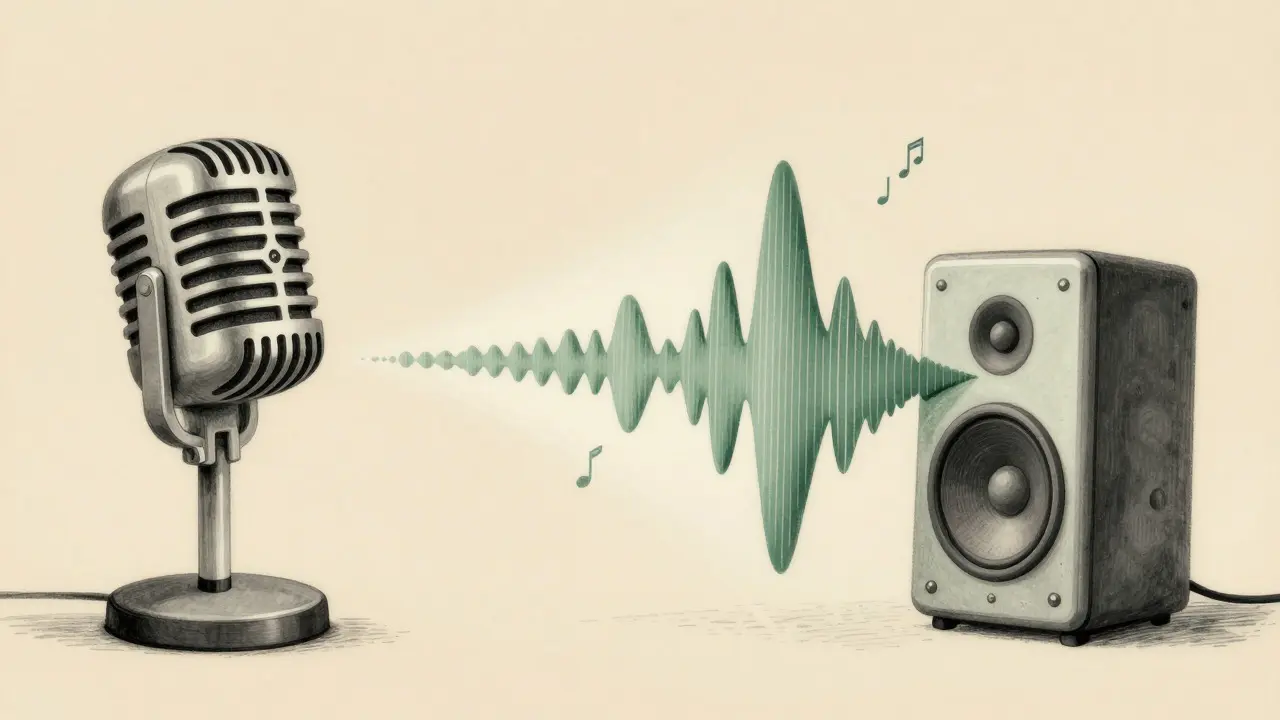
While speech and music grab the headlines, Sound Effect Generation is the AI-driven creation of ambient noises, foley sounds, and environmental audio from text descriptions. This is critical for games, film, and virtual reality. Recording every possible footstep, explosion, or wind gust is expensive and time-consuming. AI changes that.
Tools like Meta's AudioGen and Stability AI's Stable Audio allow creators to prompt for specific sounds. Type "heavy footsteps on gravel," and the model generates a stereo clip that matches the description. These systems are particularly good at environmental textures-rain, traffic, crowds-that form the backdrop of immersive experiences. Because sound effects are shorter and less structurally complex than music, diffusion models perform exceptionally well here, producing crisp transients and realistic spatial qualities.
Comparing the Top Tools
Choosing the right tool depends on your specific needs. Are you looking for quick voiceovers, full song composition, or game assets? Here is how some of the leading platforms stack up.
| Platform | Primary Focus | Key Strength | Best For |
|---|---|---|---|
| ElevenLabs | Speech & Voice Cloning | Ultra-realistic multilingual voices | Dubbing, Audiobooks, IVR |
| Suno | Full Song Generation | Lyrics + Vocals from text | Social Media, Indie Artists |
| Stable Audio | Music & SFX | Precise control over duration/BPM | Game Dev, Background Tracks |
| Meta AudioCraft | Research/Open Source | Transparency & Fine-tuning | Developers, Researchers |
Notice the trade-off between ease of use and control. Consumer apps like Suno prioritize speed and simplicity, hiding the technical complexity behind a chat interface. Professional tools like Stable Audio offer more knobs and dials, such as setting exact beats per minute, which is crucial for syncing music to video. Open-source libraries like AudioCraft give developers full access to the code, allowing for custom fine-tuning but requiring significant GPU resources and ML expertise to deploy effectively.
Challenges and Ethical Considerations
No technology is without its pitfalls. In audio generation, the biggest issues revolve around copyright and authenticity. When a model trains on copyrighted music or voices, who owns the output? The April 2023 viral track imitating Drake and The Weeknd sparked intense debate. Labels argued it was infringement; fans called it art. Legal frameworks are still catching up.
Then there is the deepfake problem. High-quality voice cloning can be used for fraud, impersonating executives in phone calls or spreading misinformation. To combat this, the industry is moving toward mandatory watermarking-embedding inaudible signals in AI-generated audio so listeners and software can verify its origin. Transparency is becoming a standard expectation, not just a nice-to-have.
Technical limitations also persist. AI music often struggles with harmonic novelty, sometimes producing "generic library music" rather than groundbreaking compositions. Speech models can still miss subtle emotional nuances, sounding flat in dramatic scenes. And while sound effects are improving, capturing complex, layered environments with precise spatial accuracy remains a challenge compared to human recording.
What’s Next for AI Audio?
The future looks bright, with several key trends emerging. First, we will see longer, more coherent music generations. Current models are pushing past the 3-minute mark, aiming for full album-length coherence. Second, multimodal integration is accelerating. Systems like AudioGPT explore agents that can both listen and speak, interacting with users in real-time through voice and visual cues. This convergence of audio and vision models will enable richer interactive experiences in gaming and education.
We also expect finer-grained control. Instead of just saying "happy song," users will be able to specify chord progressions, dynamic shifts, and even individual instrument layers. For speech, we will see more expressive prosody, with voices that laugh, sigh, and emphasize words naturally based on context. As hardware costs drop and models become more efficient, these capabilities will move from cloud services to local devices, enabling offline generation and greater privacy.
Ultimately, audio generation is shifting from a novelty to a utility. It is becoming a fundamental tool in the creator's toolkit, alongside editing software and cameras. Whether you are localizing a video game, producing a podcast, or scoring an indie film, AI audio offers a way to scale creativity without scaling costs. The question is no longer if you should use it, but how to integrate it into your workflow effectively.
What is the difference between speech synthesis and voice cloning?
Speech synthesis (TTS) converts text into speech using a generic or pre-defined voice model. Voice cloning is a subset of TTS where the model adapts to a specific person's voice characteristics using a small sample of their audio, allowing it to generate new sentences in that person's unique voice.
Can AI generate music with vocals?
Yes. Modern platforms like Suno and Jukebox can generate full songs including instrumental tracks and vocal performances. These models are trained on datasets containing both music and lyrics, allowing them to synchronize singing with the underlying harmony and rhythm.
Are AI-generated sounds royalty-free?
Generally, yes, but it depends on the platform's license terms. Most commercial tools grant broad usage rights for the output. However, legal clarity regarding training data copyright is still evolving. Always check the specific End User License Agreement (EULA) of the service you are using, especially for commercial projects.
Which architecture is best for generating sound effects?
Diffusion models are currently considered superior for sound effects due to their ability to handle complex textures and maintain global coherence. They excel at generating ambient noises and transient events like explosions or footsteps with high fidelity, outperforming earlier GAN-based approaches in human preference tests.
Do I need a powerful computer to run these tools?
For cloud-based services like ElevenLabs or Suno, no special hardware is needed-just a web browser. For open-source models like Meta's AudioCraft or local LLM-integrated TTS, you typically need a modern NVIDIA GPU with at least 8-16 GB of VRAM to run inference efficiently.